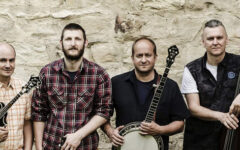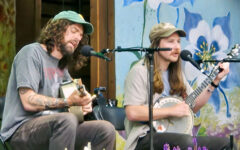

Lluís Gómez’s obsession with music began early on. His interest was nurtured early on in his hometown of Premià de Mar, located near the sea about 20 km north of Madrid, and the place he still calls home. He began teaching himself acoustic guitar and electric bass as a child. He later went on to study flute for two years and once he reached the age of 18, he began pursuing studies in classical guitar at the Music School of Premià de Mar. He later took up the electric guitar and began learning harmony while taking classes at Barcelona’s Municipal School of Music.
“I’ve had many influences, mostly from my family,” Gómez says. “Nobody in my family played an instrument, but music was always around — on the radio or on vinyl. I love classical, jazz, blues, Irish, manouche, and flamenco. However, due to the 40 years of Franco, Spain was somewhat frozen in time, which made finding music difficult.”
At the age of 30, he learned fiddle, teaching himself at first before progressing to more formal training later on. Nevertheless, it was his initial encounter with bluegrass, courtesy of the Banjo Paris Session album, which made the most enduring impression.
“It was released in Spain thanks to a Spanish label called Guimbarda,” he recalls. “As I mentioned, it was difficult to find music back then. I still remember listening to Mr. Glubo, an instrumental tune by my first banjo hero (and now friend) Jean-Marie Redon. We even recorded an album together in 2020. But then COVID happened… and that’s another story!”
In fact, Gómes was so impressed by the music he was hearing that he immediately became drawn to the 5-string banjo, which compelled him to take lessons in Barcelona. Afterwards, he travelled to France, Ireland, the UK, and the US to take lessons from such fabled musicians as Jean Marie Redon, Bill Keith, Tony Trischka, Pete Wernick, Noam Pikelny, Béla Fleck, Adam Larrabee, and Jayme Stone, among others.
“When it comes to banjo, I have many influences,” Gómez insists. “Of course, there’s Earl Scruggs, Bill Keith, Tony Trischka, and Béla Fleck on 5-string, and Gerry O’Connor on 4-string. After I discovered Earl Scruggs and Bill Monroe, my journey then took me to Paris.”
Since then, he’s performed and recorded with any number of artists and ensembles in an array of styles. He’s also contributed music for several films and performed theatrically as both a musician and actor.
“I’m not someone who sticks to just one style,” Gómez maintains. “When I was a teenager, it was the time of heavy metal and hardcore, so I followed that music. Honestly, I regret it a bit — it’s great music, but I think it was a way of not thinking and just following the ‘rules.’ Nowadays, I listen a lot to classical and flamenco. Like everyone, it depends on the moment in my life. Since COVID, I’ve come to love silence. So many times when I’m cooking — and I love cooking! — I’m not listening to music the way I used to.”
Nevertheless, Gómez remains well known for his work both at home and abroad, courtesy of three albums featuring his original material. He’s especially well known as one of Spain’s leading proponents of bluegrass music, and he’s written several method books on how to learn to play the five string banjo, including a Spanish-Catalan bilingual book written in collaboration with Toni Giménez. A multi-instrumentalist, he also plays mandolin and co-authored the book, The Bluegrass Violin, which was written in both English and Spanish. His other books include Fun Solos to Play, Early Classic Gems, An Early American Christmas, and Christmas in the British Isles, all courtesy of Mel Bay Publications.
“In 2024, I wrote a book called The John Reischman Banjo Book, Gómez continued. “John was personally involved in the project, and two good friends helped me along the way — Marc Pirson from Belgium assisted with the text and Marina Vinardell handled the graphic design here in Barcelona.”
Gómez has also shared stages with Bill Keith, Tony Trischka, Jayme Stone, Alex Hargreaves, Mike Barnett, Jean Marie Redon, Chris Luquette, Scott Law, Steve Kaufman, Henrich Novák, Casey Driessen, Mark Schatz, John Reischman, Emory Lester, Bill Evans, and Gerry O’Connor, among others.
“Last summer, one of my highlights was playing Paco de Lucía’s tune Entre dos Aguas with Béla Fleck, Hank Smith, Casey Driessen, and Mark Schatz,” he recalls. “Can you imagine? Béla was one of the people who supported my Flamenco banjo journey. And with John and Casey, we performed a show called Mediterranean Ensemble at Tradicionàrius, the most well-known venue in Barcelona for Catalan music.”
In addition, Gómez runs the bluegrass and old-time Music Festival Al Ras, as well as the Barcelona Bluegrass Camp. He also teaches at the prestigious International Stage Musique Acoustique Campus in Belgium and at various other workshops all around the world. He’s been an assistant teacher for Béla Fleck at the prestigious Blue Ridge Banjo Camp and has taught Banjo Flamenco workshops in that locale as well. So too, he hosts bluegrass sessions in Barcelona and teaches classes in banjo, mandolin, and violin, all in addition to performing in various bluegrass, folk, and jazz manouche bands.
“Actually, I teach in different settings,” he explained. “I offer private lessons at my place, in two music schools, and online. I’ve also taught workshops in many European countries and in the USA.” His latest album, Dotze Temps, consists mostly of original material in addition to two traditional tunes and a pair of covers. “The idea was to follow the spirit of the FlamenGrass album by bringing together international musicians,” he explains. “They included Ondra Kozák from the Czech Republic on guitar and Raphaël Maillet from France on violin — and of course, Maribel Rivero on double bass and vocals. It was really interesting to work on Spanish and Catalan songs with Ondra and Raphaël. They added some beautiful colors to the music.”
As a result, there’s been an enthusiastic response all round. “I’m so happy with the reaction — from the bluegrass and folk scenes, as well as from my music friends,” Gómez says. ‘Over the course of a year, the album was featured in major magazines and received some great reviews. We played at some big festivals, and thanks to its international lineup, it became an eclectic album that mixed bluegrass instruments with Spanish and Catalan roots music. It was a dream to record a tune with just banjo and hand clapping. Plus, I chose Catalan and Spanish music so that people can better understand it. Banjo music is not very well known here, but I have to say that when people hear the banjo for the first time, they really like it. It’s a big surprise.”
He added that he’s already working on his next album, which will find him continuing to pursue a similar direction.
“I feel honored and proud that here in my country, my work is respected — both as a musician and for spreading bluegrass and old-time music through the festivals and camps organized by the Al Ras association,” Gómez continues. “We have a great team!”
He also credits bluegrass for bringing people together. “It’s the community that makes it special,” Gómez suggests. “Thanks to the songs, tunes, and instrumentation, people want to play, have fun, and share something. That’s the essence of folk music. I’ve visited many countries and met people I had never met before, just saying, ‘I’m a bluegrass musician visiting your city, where’s the jam session?,’ and they say, ‘You can stay at my place!’ And vice versa! Here in Barcelona, with the Al Ras Association, we’re really honored to see so many people coming and discovering the community we have. Friendship, family… call it what you like — but the language in common is bluegrass and old-time! Stay in tune, listen to music, and keep looking for inspiration!”