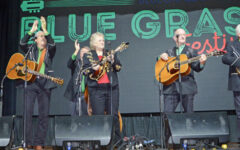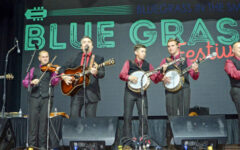

Rapidgrass featuring Pete Wernick at Bluegrass in La Roche 2025 – photo © Algelika Hernmarck
This report on day two at France’s Bluegrass in La Roche festival is a contribution from Swiss bluegrass writer and promoter Angelika Hernmarck. She will provide a daily update this week as the music rolls on.
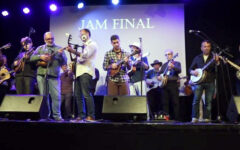
I hope you’ve enjoyed my impressions so far – because yesterday brought another unforgettable day, starting at 5:30 p.m., with a bang: the performance of 13 different formations made up of students from the La Roche Bluegrass Workshop.
Since Monday evening, over 140 students have been rehearsing and learning up at the girls’ boarding school above the village, under the guidance of – I believe – 14 instructors from France and the US. They first worked in instrument classes and then formed jam groups, eventually creating the ensembles that each performed one piece on the big stage. As expected, the playing levels varied – from beginners to more advanced – but the energy? Incredible across the board. You could feel what this workshop experience does for the participants. It’s not just about learning; it’s about community and joy.
Afterward, I briefly spoke with Gilles Rézard, the man behind the workshop. He seemed relaxed and truly happy with the results, calling this a particularly good year – not least due to the presence of Pete Wernick, who taught both banjo and jamming, bringing his trademark spark and valuable insights that lifted everyone involved.
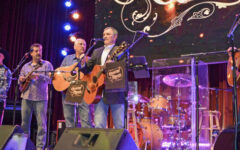
To round out the segment, the European instructors gave a short set – and what a treat it was! It became clear just how much talent our European musicians have to offer. I was particularly intrigued by Gilles Rézard’s melodic banjo playing, and by Patrick Peillon, whose strong “High Lonesome” lead vocals paired perfectly with harmonies of Dorian Ricaux, who in turn was once a teenage student at the very first camp (then organized by Pierre Bastide), and now stood confidently, as a teacher and multi-instrumentalist, on mandolin and harmony vocals. On bass, Marie Clémence – who actually led the “false beginners” class for mandolin and guitar – delivered a solid, tasteful foundation. The overall level of teaching at the camp is top-notch, which explains why the 2026 edition already has a waiting list of over 30 names!
At 8:00 p.m., the European All-Stars Band took over – a group formed especially for the festival, and consisting of five top players from five different countries. They presented a set that ranged from traditional to more progressive material. I was very impressed by Evan Davies from the UK-based band, The Often Herd – his mandolin playing and vocals were outstanding. Fiddler and singer Joram Peeters (Belgium) guided the audience through the set, introduced the bandmates, and even led some sing-alongs. The lineup also featured Lluís Gómez (banjo, Spain) of Barcelona Bluegrass Band, Pierce Black (bass, Ireland) from Stereo Naked, and Vladimir Križan (guitar, Czech Republic) of G-Runs ‘n Roses. A true first class performance – I loved every minute of it.
Then came the official opening of the festival. Festival directors Didier Philippe and Christopher Howard-Williams were joined on stage by several regional and city dignitaries, all expressing their support for this now-iconic event. To close the ceremony, they announced a birthday cake – big enough for 3,000 people! And they weren’t exaggerating. The square was absolutely packed with music lovers taking advantage of the free entry on this beautiful, warm Thursday evening. 3,000 people on a “regular” Thursday – now that’s impressive. And the mood? Joyful, celebratory, and buzzing with anticipation. The cake, by the way, consisted of small cream-filled puffs – vanilla, chocolate, or coffee – something like miniature éclairs. Absolutely delicious!
It’s worth highlighting once again the incredible organization of this festival. A core team of 15 people work all year round, joined closer to the event by 20 more area leads, and then supported by (this year) 267 volunteers – the friendly faces you see everywhere, in their green shirts this year, helping guests feel welcome and taken care of.
This year, the sound from the big stage is enhanced by a large video screen showing live footage from three or four cameras. Between performances, they also display sponsor messages and honor volunteers and friends of the festival who’ve passed away over the past 20 years – a sobering but meaningful tribute.
Also on-site: the Luthiers & Accessories Hall (I’ll explore it properly today), the bustling festival market, kids’ programming, and – for the musicians – the all-important Free Instrument Check service.
After the opening ceremony, the next band up was Tanasi from the USA. Three of its members had already played here in other formations in past years: Anya Hinkle (guitar), Billy Cardine (dobro), Mary Lucey (clawhammer banjo and bass), and Andrew Finn Magill (fiddle). Together, they presented old-time music in a fresh, energetic, and virtuosic way. Anya and Mary’s vocals were rich and memorable, and their repertoire showed influences from all around the world – not surprising, considering their extensive touring and global collaborations. Their message: music as a connector across all borders. And what a beautiful message that is.
The evening ended – about an hour behind schedule – with the much-anticipated Main Stage set by Rapidgrass, featuring Pete Wernick. And once again, they thrilled me with their creative arrangements and spontaneous twists. One standout moment: their version of Nellie Kane (a Hot Rize classic) suddenly veered into Pink Floyd’s Another Brick in the Wall during a long instrumental break… then seamlessly modulated back to Nellie Kane. A musical detour that left the crowd cheering. The band’s deep love for mountains, nature, and this festival was tangible throughout the set.
Another highlight was I-70, a song written by Mark Morris and sung by Alex Johnstone, about the frustration of being stuck in traffic on Interstate 70 – trying to make it to a bluegrass festival. In the instrumental break? Duke Ellington’s Caravan – yes, really – which then wound its way back to the traffic jam. Wild, witty, and brilliant.
It was a long day filled with music and many more reunions. Sadly, I didn’t quite make it to the very end – I had to head home, accompanied by the sweet sounds of bluegrass echoing behind me.
Today holds even more in store: jamming on the campground (I still need to go there!), a dobro workshop with Billy Cardine (organized by the European Bluegrass Music Association as a satellite event), and an important session at 4:00 p.m.: a “Call to Join the Research Network on the History of European Bluegrass” at the maison des associations.
At 6:00 p.m., the main stage program begins again, featuring four fantastic bands from Europe – and, of course, the one and only Della Mae from the USA. Plenty to see, plenty to hear!
My photos can only capture a hint of what this all truly looks and feels like. Later on, we’ll share galleries by the amazing festival photographers – including Emmanuel Marin and Odile Glaine – who are doing a fantastic job documenting it all.
And now I really have to run… see you back here tomorrow!
→ Missed Chapter Two? Read it here